
Introduction
“Link building doesn’t work anymore.”
This is one of the most common conclusions SEO buyers reach in 2026 and in most cases, it’s wrong. Link building hasn’t stopped working. Poor link-building decisions have.
Buyers arrive at this conclusion after months of spending, reporting, and waiting. Links are built. Content is published. Rankings move slightly then stall. Leads don’t increase. Confidence disappears.
This article explains why link building isn’t working for so many businesses in 2026, what breaks behind the scenes, and what experienced buyers fix before deciding to abandon SEO altogether.
Why This Problem Is Being Searched More Than Ever
Competitor keyword data shows a clear trend: searches related to “SEO not working”, “backlinks not effective”, and “ranking not improving” are rising.
This happens because:
- Google evaluates trust more strictly
- cheap links decay faster
- competition is more authority-driven
Buyers aren’t searching for tactics. They’re searching for explanations.
Problem #1: Authority Is Being Built, But in the Wrong Places
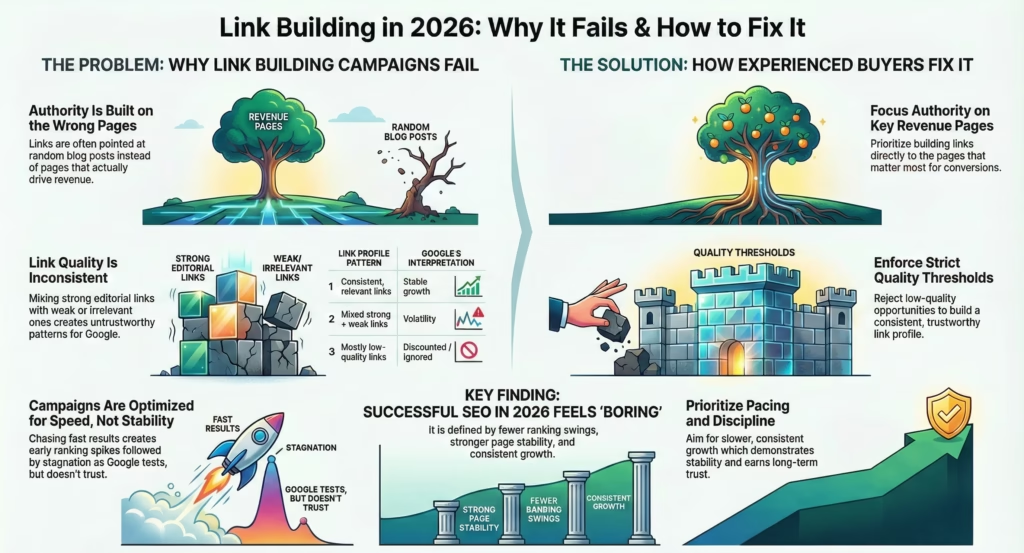
One of the most common failures is misplaced authority.
Links are often built to:
- random blog posts
- low-impact pages
- content with no commercial role
Meanwhile, pages that actually drive revenue remain unsupported.
This creates a false sense of progress. Visibility increases, but nothing flows to conversion, a pattern explored in why backlinks alone don’t increase leads.
Link building works just not where it’s being applied.
Problem #2: Link Quality Is Inconsistent
Google does not evaluate links individually. It evaluates patterns.
When strong editorial links are mixed with weak, irrelevant, or automated placements, trust becomes unclear. Rankings may test briefly then fail to hold.
Table 1: How Google Interprets Link Quality Patterns
| Link Profile Pattern | Outcome |
|---|---|
| Consistent, relevant links | Stable growth |
| Mixed strong + weak links | Volatility |
| Mostly low-quality links | Discounted |
| Automated patterns | Suppression risk |
This is why cheap link building fails in 2026 not immediately, but structurally.
Problem #3: Campaigns Are Optimized for Speed, Not Stability
Many agencies still chase early wins.
To show fast movement, they:
- scale link volume quickly
- push aggressive anchors
- skip context checks
This often creates early ranking spikes followed by stagnation. Buyers experience this as “SEO worked, then stopped.”
In reality, Google was testing, not trusting.
Problem #4: Buyers Are Watching the Wrong Signals
Most buyers track:
- keyword positions
- link counts
- domain metrics
Experienced buyers track:
- index retention
- recovery speed after drops
- page-level authority concentration
- enquiry quality trends
When buyers don’t know what to watch, they assume failure too early or too late.
This diagnostic gap is common in campaigns discussed in why link-building campaigns fail after 3–6 months.
Problem #5: Strategy Was Never Clear
If an agency cannot clearly explain:
- why specific pages are supported
- why certain sites are chosen
- what should improve next
then the campaign is likely execution-driven, not strategy-driven.
This is the exact warning sign outlined in how to choose the right link-building agency in 2026.
What Top SEO Buyers Fix First
When experienced buyers realize link building isn’t working, they don’t panic. They recalibrate.
They fix:
- Page prioritization — only key pages get authority
- Quality thresholds — no mixed signals
- Anchor discipline — restraint over aggression
- Pacing — stability over speed
- Explanation — clarity over volume
This shift almost always restores momentum.
What “Working Link Building” Looks Like in 2026
When link building works, buyers notice:
- fewer ranking swings
- stronger page stability
- slower but consistent growth
- improved lead relevance
It feels boring and that’s a good sign.
This behavior aligns with outcomes seen in manual link building in 2026, where precision beats scale.
Final Analysis
Link building isn’t broken in 2026.
Decision-making around it is.
Most failures come from misplaced authority, inconsistent quality, and unrealistic expectations. Buyers who fix these variables stop chasing tactics and start building trust.
That’s when SEO starts working again.
If link building feels ineffective, the solution isn’t more links.
It’s better decisions about where, how, and why authority is built.
That’s where real growth begins.