
A recent analysis of 50,000 ranking pages found that referring-domain count had a stronger correlation with search position than any other single factor measured, including page speed, word count, and schema markup. If you’ve ever wondered how does link building help SEO, that single statistic answers the question better than most theory ever could: pages with more quality backlinks consistently outrank pages without them.
Link building is the process of earning hyperlinks from other websites back to your own. Every one of those links acts as a signal to Google that your content is worth trusting. But the “why” behind that signal is more layered than most guides let on, and understanding the mechanics is what separates link building that moves rankings from link building that just adds noise to your backlink profile.
This guide breaks down exactly how link building helps SEO, what the current data says about it, and how to build links that actually work in 2026.
Quick Answer:
Link building helps SEO by earning relevant backlinks from other websites. Quality backlinks can help search engines discover pages, strengthen a site’s authority and relevance, and bring referral traffic. The value of a link depends on the quality, relevance and context of the website linking to you.
What Is Link Building, Exactly?
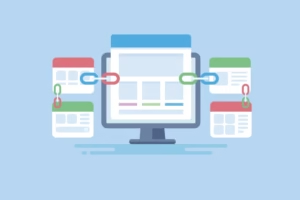
Link building is a term used for getting backlinks from other sites. This is how search engines found out about the existence of the Web before there were ranking algorithms; they follow links from one page to another and from one site to another.
Later on, Google made this discovery process work as a signal of trustworthiness. Linking to your website from another site resembles citing in academic writing; one citation from an established source is worth more than many citations from unknown sources. The same principle works at Google’s ranking algorithms.
How Does Link Building Help SEO? 6 Core Mechanisms
1. It Signals Authority and Trust to Search Engines
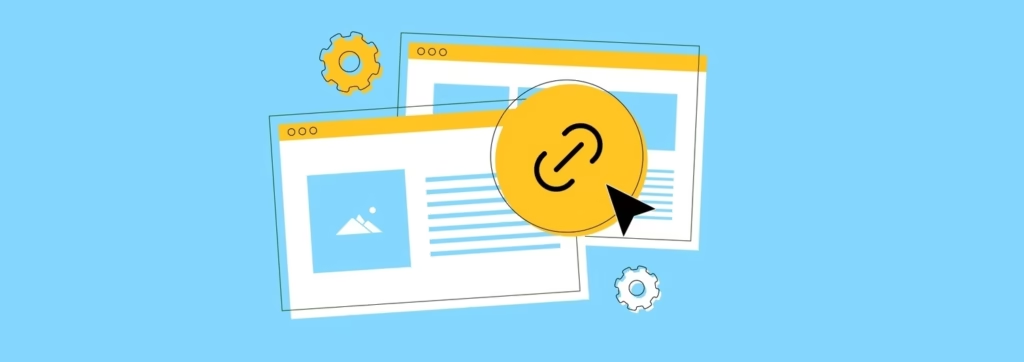
It cannot interpret intentions and reputation in the way people do, so it depends on proxies. One of the most effective proxies that could be applied is a backlink from a trusted and topic-related website. If several trusted websites have links pointing to the same page, then Google sees this as independent verification that the page is valuable enough to be indexed.
That is why the number of referring domains, which is the amount of unique sites pointing to you, not just the quantity of links, correlates better with rankings than sheer backlink quantity. For example, ten links from ten unique reliable websites usually work better than one hundred links from a single unreliable website.
2. It Improves Crawling and Indexing Speed
Google must first find the page and index it before ranking can happen. Backlinks provide new entry points for Googlebots to crawl through, and this is extremely important for new pages and newly registered websites that do not have a known crawl schedule yet. A link from a regularly crawled and highly authoritative website will help you to get indexed much quicker than waiting for a natural crawl cycle.
3. It Drives Direct Referral Traffic
Regardless of ranking, backlinks can serve as sources of traffic on their own. If you have an article on an industrial website, and someone visits your page using a link from there, it will be a user who already knows what he or she is looking for. In contrast to a random search engine visitor, the user was qualified by the website that sent him or her to your page.
4. It Builds Topical and Domain-Level Relevance
It’s not only authority that links pass along, but context as well. When someone in your industry links to your website, it’s telling Google something that any other link isn’t telling: your content has enough value for people interested in your niche to link to it. This is one of the reasons why sometimes one link from a highly relevant blog may outrank several links from general websites.
5. It Compounds Across Your Whole Domain
Backlinks not only benefit the page that they lead to. The backlinks that you receive will improve the domain authority of your website, giving all of your other pages a slight edge in the rankings as well. This is why many older websites tend to outrank newer websites with similar quality content.
6. It’s Becoming More Important, Not Less, in AI Search
Since the emergence of AI-generated answers and overviews in search results, multiple studies carried out in 2025-2026 showed that AI systems tend to use and cite authoritative and highly linked content more frequently. The authority of backlinks is not only valuable when ranking in blue links – this is now crucial for getting cited in AI-generated answers.
| Backlink Type | Potential SEO Value | Why |
|---|---|---|
| Relevant editorial link | High | Relevant context and genuine editorial value |
| Industry publication | High | Relevant audience and trusted source |
| Relevant guest contribution | Medium to High | Useful content on a genuine industry website |
| Unrelated directory | Low | Little topical relevance |
| Spam link network | Risky | Can violate search engine spam policies |
What Makes a Good Backlink?
- The linking website is relevant to your industry.
- The page has genuine value for its readers.
- The link fits naturally within the content.
- The website has real users and useful content.
- The link isn’t created purely to manipulate rankings.
What the Data Actually Shows
Link building has a reputation for being hard to measure, but recent large-scale studies give a clearer picture than ever:
- Analyses of over a million top-ranked keywords have found referring domains correlate with search position more consistently than most other ranking signals, with the relationship strengthening further for local search queries.
- Backlinko’s analysis of nearly 12 million search results found that top-ranking pages consistently carry more backlinks than lower-ranking ones, with the #1 result averaging close to four times as many backlinks as pages in positions two through ten.
- A separate 2026 study covering 41 million referring backlinks found that roughly two-thirds of all indexed pages have zero backlinks at all – meaning even a modest, well-earned link profile can put you ahead of the majority of competing content.
The consistent theme across every recent study: it’s not link volume that drives rankings, it’s the number and quality of unique referring domains.
Do Backlinks Matter More Than Content?
Backlinks and content work together. A strong backlink profile won’t make poor content useful to searchers, while excellent content may struggle to compete if few reputable websites reference it. The strongest SEO strategy combines useful content with relevant, earned links.
A Simple Link-Building Process
- Identify pages that need stronger authority.
- Research relevant websites in your industry.
- Create useful content worth referencing.
- Find relevant outreach opportunities.
- Earn or request editorially appropriate links.
- Review your referring domains and link quality.
How to Build Backlinks That Actually Help SEO
Create Content Worth Linking To: Data studies, original research, comprehensive guides, and free tools consistently earn more organic links than generic blog posts, because they give other site owners a concrete reason to cite you.
Use Digital PR and Data-Driven Outreach: Publishing an original study, survey, or dataset and pitching it to journalists and industry publications is one of the most reliable ways to earn links from high-authority domains at scale.
Try Guest Posting on Relevant Sites: Submitting researched pieces for publication in reputable sources related to your field of operation is still an effective method of acquiring contextual backlinks – provided that the source websites have legitimate readership, not only backlink offerings.
Use Broken Link Building: Finding dead links on relevant sites and suggesting your own content as a replacement is a low-friction way to earn links, since you’re solving a problem for the site owner rather than just asking for a favor.
Reclaim Unlinked Brand Mentions: If other sites mention your brand or content without linking to it, a quick outreach email asking them to add the link is often one of the easiest wins available.
Build Relationships, Not Just Links: The strongest, longest-lasting backlink profiles usually come from genuine relationships with people in your industry – journalists, bloggers, and site owners who link to you repeatedly because they trust your content, not because of a one-time ask.
Benefits
- Can strengthen website authority.
- Can help search engines discover content.
- Can bring referral traffic.
- Can increase brand visibility.
- Can support competitive SEO campaigns.
Limitations
- Good links take time to earn.
- Low-quality links can create SEO risk.
- Links alone won’t fix poor content.
- Results vary by industry and competition.
- Link profiles need ongoing monitoring.
Common Link Building Mistakes to Avoid
- Volume trumping relevance: In some cases, a hundred bad links might not help your rankings as much as just five good links – and sometimes bad links can even be harmful.
- Underutilizing anchor text diversity: Anchor texts that are overly-optimized or identical could appear suspicious to Google’s algorithm.
- Purchasing links from poor quality link networks: Any paid link building efforts that break Google’s guidelines risk getting your site penalized.
- Considering link building a one-time endeavor: Since backlinks can get broken over time, any ongoing efforts at link building will always beat out a one-time attempt.
Link Building SEO Checklist
✓ Target relevant websites
✓ Create content worth linking to
✓ Prioritise quality over volume
✓ Keep anchor text natural
✓ Monitor referring domains
✓ Avoid manipulative link schemes
The Bottom Line
Link building helps SEO by signaling authority, speeding up indexing, driving qualified referral traffic, and compounding domain-wide trust — and the data shows that relationship has only gotten stronger as AI search has entered the picture. The sites winning in 2026 aren’t the ones with the most links; they’re the ones with the most relevant links from real, authoritative sources.
If you’d rather not chase links manually, YourLinkBuilder handles the outreach, vetting, and placement so you can focus on the content that earns them in the first place.
FAQ
Q: Does link building still work in 2026?
Ans: Indeed it does. The latest research on ranking factors, done by such prominent sources as Ahrefs and Backlinko, proves that referring domains and backlink amounts are one of the top ranking signals that we have.
Q: How many backlinks do I need to get a high ranking position?
Ans: The quantity is not that important. Instead, it’s the quality of backlinks from unique referring websites and their authorities in comparison with the authorities of your competition that really counts.
Q: Does link building still matter with AI search becoming popular?
Ans: It’s even more important than before. Answers generated by the AI algorithms often use and quote other sources which already have significant authority and backlink amounts.
Q: Why is backlinking considered valuable?
Ans: Valuable backlinking is typically done from a relevant and legitimate website that is part of a meaningful piece of content.
Q: Can bad backlinks cause SEO trouble?
Ans: Link manipulation techniques can be a major problem for SEO efforts. Try to get relevant links instead of concentrating only on link building.
Q: How long do links take to work?
Ans: This depends on many factors like the website involved and the link’s value. The effect of a link can take weeks or months to show up.