
Digital PR link building is the practice of earning backlinks by getting a brand covered in real journalism, rather than by asking a website owner directly for a placement. You build something a reporter genuinely wants to reference an original data study, a timely expert take, a well-run survey and the link arrives naturally, placed by the journalist inside a real news story. It matters more heading into the rest of 2026 because both traditional search rankings and AI answer engines increasingly weight editorial, third-party validation more heavily than a link a brand placed on its own behalf.
What Digital PR Link Building Actually Means
Digital PR is often confused with “getting featured in the press,” but for link building purposes it’s narrower and more mechanical than that. The goal isn’t brand awareness for its own sake it’s producing a piece of original material (research, data, commentary, or a genuinely new angle on a live news story) that a journalist can cite as a source, with a link back to where the material lives on your site.
That distinction matters because it changes what you build. A generic company blog post won’t get picked up by a reporter. A structured data set, a survey of a defined audience, an analysis of publicly available numbers nobody else has bothered to compile, or a credentialed expert willing to go on record for a fast-moving story those get picked up, because they solve a problem journalists have every day: a deadline, and not enough time to generate original reporting from scratch.
Digital PR vs. Guest Posts vs. Niche Edits
None of these tactics are mutually exclusive, and a mature link-building program in 2026 typically runs more than one at once. But they behave differently, and buyers evaluating where to put budget should understand the trade-offs before committing.
| Factor | Digital PR | Guest Posts | Niche Edits / Link Insertions |
|---|---|---|---|
| Where the link sits | Inside a news article, placed by a journalist | Inside content the brand (or its writer) authored | Inside an existing, already-published article |
| Editorial control | None the outlet decides if, how, and whether to link at all | High the brand controls the anchor text and surrounding content | Moderate the brand proposes the edit, the publisher approves it |
| Typical turnaround | Days to a few weeks per placement, once an angle lands | 1–3 weeks per placement | Days to a couple of weeks |
| Cost driver | Time and skill to build a pitchable asset and run outreach | Content production plus the site’s placement fee | The site’s placement fee, usually lower than a full guest post |
| Best for | Domain-diverse, editorially credible links and brand mentions that support AI-search visibility | Predictable, controllable placements on a schedule | Fast, budget-efficient contextual links on existing pages |
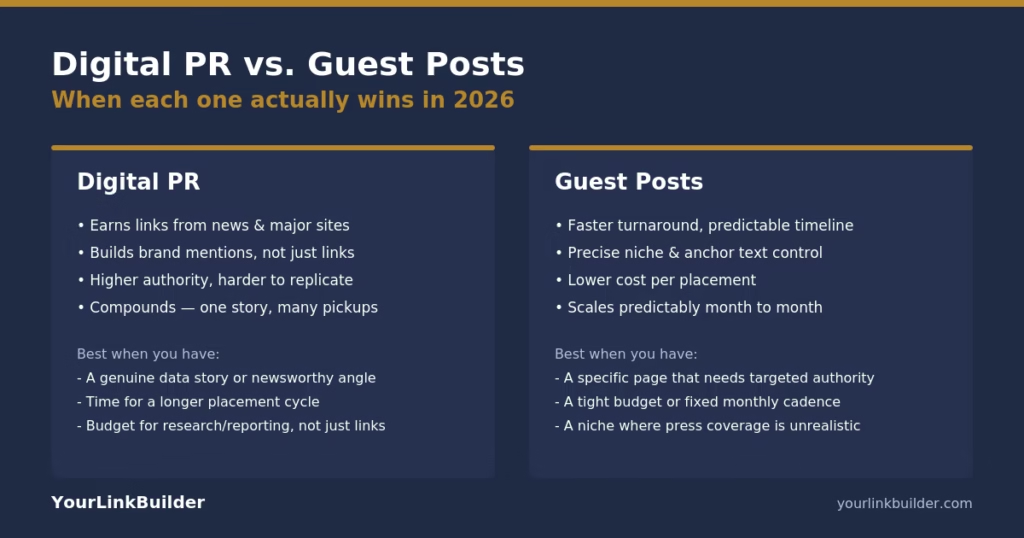
The practical takeaway: digital PR tends to produce fewer, but more editorially credible, links per campaign than guest posting or niche edits and because the outlet decides whether and how to link, it can’t be scheduled with the same precision. That’s the trade buyers are making when they choose it: less control, in exchange for links a search engine (or an AI model evaluating source credibility) is more likely to treat as an independent, third-party signal rather than brand-authored content.
How a Digital PR Campaign Actually Works
Digital PR is often pitched as glamorous, but the mechanics are closer to running a small newsroom than running a marketing campaign. Here’s the sequence that consistently produces placements.
1. Find an angle worth covering
Every successful digital PR campaign starts with a hook a journalist can use, not a product a brand wants to promote. That usually means one of a few formats: an original survey of a defined audience, an analysis built from public data nobody has bothered to compile in that form, a timely expert reaction to something already in the news, or a proprietary data set from the business itself (aggregated and anonymized). The test is simple would this be interesting to someone who has never heard of the brand and doesn’t care what it sells?
2. Build a journalist list, not a spray list
Mass-blasting a press release to a generic media list is close to the least effective version of this tactic. What works is identifying a smaller list often somewhere in the dozens, not hundreds of journalists and freelancers who cover the exact beat the story fits, and tracking what they’ve recently written so the pitch can reference their own prior coverage.
3. Use HARO/Connectively and similar platforms as one channel, not the whole strategy
Source-matching platforms (Connectively, formerly HARO, along with Qwoted and similar services) are a legitimate and fast way to get in front of journalists actively looking for a quote on deadline. They work best for expert commentary and reactive pitches, and worst as the sole strategy, since a large share of the pitches submitted through them are off-beat for the query and get filtered out immediately. Speed matters more here than almost anywhere else in link building queries are typically filled by whichever qualified source responds first with a usable, on-topic quote.
4. Pitch like a reporter, not a marketer
The single biggest reason pitches get ignored is that they’re written to sell something rather than to hand a journalist a usable story. A pitch that leads with the data point or the finding, in one or two sentences, with the brand’s relevance explained afterward, consistently outperforms a pitch that opens with a company boilerplate paragraph.
5. Follow through after the placement
Once a story runs, check whether the link points where it should, is live (not nofollowed in a way that defeats the purpose, though even nofollowed editorial mentions still carry brand-signal value), and follow up if it’s missing. Then keep the relationship going a journalist who got a fast, accurate, on-topic response once is far more likely to come back for the next story on that beat.
Common Mistakes That Kill Digital PR Campaigns
- Treating it as a one-off project. A single campaign might land a handful of placements; a sustained program of monthly or quarterly campaigns is what builds a real footprint of editorial links over time.
- Pitching the product instead of the story. Journalists don’t cover companies as a favor. They cover stories that serve their readers.
- Ignoring the journalist’s actual beat. The most common reason a pitch gets rejected outright isn’t quality it’s irrelevance to what that specific reporter covers.
- Skipping the follow-up. Placements sometimes publish without the link, or with the wrong URL. If nobody checks, the campaign’s ROI quietly drops.
- Expecting guest-post-level control. A brand can’t dictate anchor text, surrounding context, or timing in digital PR the way it can in a guest post. Buyers expecting that level of control are usually better served starting with guest posts or niche edits and layering in digital PR once expectations are calibrated.
When Digital PR Beats Guest Posting and When It Doesn’t
Digital PR tends to win when the goal is domain diversity from genuinely authoritative, editorially independent sources, when the brand has (or can produce) real data or credentialed expertise worth citing, and when brand mentions in trustworthy outlets matter as much as the link itself which is increasingly the case as AI-driven search and answer engines factor in how often and how credibly a brand is mentioned across the web, not just how many links point to it.
Guest posting and niche edits still win when a program needs predictable volume on a fixed schedule, when budget and timeline don’t allow for the research or asset-building digital PR requires, or when the goal is contextual links on very specific, already-ranking pages rather than broad authority and mentions. Most well-run link-building programs blend both: guest posts and niche edits for steady, controllable placements, and digital PR layered in for the harder-to-earn editorial links that move the needle on overall domain trust.
Building a Digital PR Program Without an In-House PR Team
The barrier most companies hit isn’t strategy it’s capacity. Running digital PR well requires someone who can identify a genuinely pitchable angle, build the underlying asset (a survey, a data analysis, an expert brief), maintain live relationships with a working list of journalists, and respond fast enough to reactive queries to actually win them. That’s a different skill set than content writing or traditional outreach, and it’s one of the reasons most in-house marketing teams either under-invest in digital PR or abandon it after one underwhelming campaign.
If the goal is a broader link-building program that mixes editorial digital PR coverage with more predictable guest post outreach, it’s worth evaluating a guest post outreach service alongside a digital PR effort rather than treating them as competing budgets the two do different jobs. For a fuller view of how digital PR fits into an overall approach, our link-building strategy guide for 2026 breaks down how to sequence tactics based on budget and timeline.
How to Measure Whether a Digital PR Campaign Is Working
Digital PR gets judged unfairly when it’s measured on the same weekly cadence as guest posting. A campaign built around an original data study or survey typically needs several weeks to move from research to a pitchable asset to actual placements, and the ranking effects of the links it earns tend to show up gradually rather than immediately. Judging a single campaign after two weeks will almost always make it look like it underperformed, even when it’s on track.
The metrics worth tracking are different from a standard link-building report, too. Referring domain count and average authority still matter, but so do a few things guest posting and niche edits don’t produce in the same way: the number of unique outlets that covered the story, whether the brand was mentioned by name (with or without a link, since unlinked mentions still carry signal for how AI tools and search engines assess a source’s credibility), and whether any of the coverage led to follow-on pickups smaller outlets or newsletters that cite the original story rather than the brand directly. That secondary pickup is often where a well-run campaign gets most of its long-term value, and it’s easy to miss if the only thing being tracked is the first wave of placements.
A reasonable way to evaluate a digital PR program after two or three campaigns: did the number of pitchable angles get easier to find as the team learned what resonates, did response rates from the journalist list improve as relationships built up, and did the resulting links land on outlets a guest post or niche edit budget could not have reasonably bought a placement on. If the answer to that last question is consistently no, the program isn’t earning its higher cost and lower predictability compared to guest posts and niche edits.
Frequently Asked Questions
Is digital PR link building the same as a press release?
No. A press release is a one-way announcement sent out broadly and is rarely picked up as a news story on its own anymore. Digital PR link building is built around giving a specific journalist something they can use in a story they’re already working on or one they’re actively considering original data, a defined survey finding, or an expert quote on a live topic. The distinction is the difference between broadcasting and being cited as a source.
How long does it take to see results from digital PR?
Building the pitchable asset and running outreach typically takes a few weeks before the first placements land, and it can take longer for a genuinely competitive story angle. From there, the SEO effect of the resulting links plays out over the following weeks as the pages get crawled, indexed, and factored into rankings it isn’t instant, and campaigns should be planned with that lag built in rather than judged against a guest-posting timeline.
Do I need an in-house PR person to do this?
Not necessarily, but someone needs to own it as a discipline identifying angles, building journalist relationships, and pitching rather than treating it as a side task for whoever writes the blog. Many brands run this through an agency or specialist for exactly that reason: it’s a different skill set from content writing or traditional link outreach, even though all three ultimately feed the same link-building goal.
Does digital PR replace guest posting?
Not for most buyers. Guest posting and niche edits are better for predictable, budget-controlled placements on a schedule. Digital PR is better for the harder-to-earn editorial links and brand mentions that carry more third-party credibility. A mature program typically runs both rather than replacing one with the other.
The Bottom Line
Digital PR link building earns backlinks the hard way by producing something worth a journalist’s time rather than asking for a placement directly. It’s slower to start and harder to control than guest posting or niche edits, but the links it produces carry a kind of editorial credibility that’s difficult to replicate any other way, and the brand mentions that come with it are increasingly relevant to how AI search tools evaluate a source. For most buyers, the right move isn’t choosing digital PR instead of guest posts or niche edits it’s sequencing all three into one program instead of running them in isolation.
If you’re weighing where digital PR fits into your link-building budget, or want a program that combines editorial coverage with the full range of link-building services we run, get in touch and we’ll walk through what makes sense for your site and timeline.