
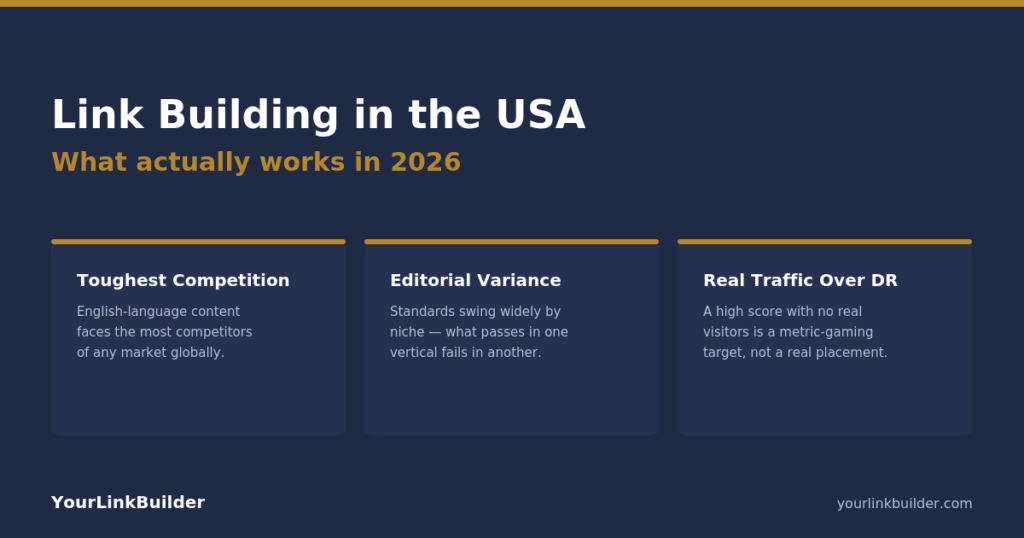
Link building in the USA in 2026 works when it treats the market as fragmented rather than uniform the US isn’t one SEO landscape, it’s dozens of them stacked by niche, each with its own competition level and editorial gatekeeping. The single biggest mistake brands make is applying one link-building playbook across a market where a personal finance site and a home-improvement blog operate under completely different rules for what gets a backlink and what gets ignored. Add regional and local competition on top of niche variance, and “the US market” stops being a useful phrase at all it’s really dozens of smaller markets that happen to share a language and a top-level domain.
Why the US Is the Most Contested English-Language Market
Every English-language SEO market competes for global attention, but the US carries a structural disadvantage none of the others do: it’s the largest advertiser economy on earth, which means more brands, more agencies, and more budget chasing the same publishers than in the UK, Germany, or any other single-country market. A publisher that would be a hidden gem in a smaller market is already fielding pitches from a dozen other buyers in the US.
That volume changes publisher behavior. US publishers with real audiences and real editorial standards get pitched constantly, which means they can afford to be selective and increasingly are, as the flood of AI-generated pitches and low-effort guest post requests has made editorial gatekeepers more cautious about what they’ll accept, not less.
Editorial Standards Vary Wildly by Niche
This is the part generic link-building advice skips: “the US market” isn’t one editorial climate, it’s several, and they don’t behave the same way.
- Finance, crypto, and other YMYL (Your Money or Your Life) niches face the tightest scrutiny. Publishers in these spaces have genuine legal and reputational exposure for what they link to, so vetting is slower, rejection rates are higher, and the sites that do accept placements tend to guard their editorial standards closely.
- Health and legal content sits close behind publishers here are cautious for the same YMYL reasons, and turnaround times tend to run longer as a result.
- SaaS, tech, and B2B occupies a middle ground: real editorial review, but a more predictable process once a publisher is confirmed as a genuine fit.
- General, lifestyle, and broad consumer niches have the largest pool of available publishers and the most variable quality this is where it’s easiest to find placements, and also easiest to end up with a low-value one if nobody’s actually checking traffic and standards.
A buyer who doesn’t know which category their niche falls into ends up either overpaying for a general-niche placement or underbidding for a YMYL one and getting rejected or ignored as a result.
National Competition Isn’t the Only Competition
Most advice about “the US market” talks about it as a single national arena, but a large share of US businesses local service providers, regional healthcare practices, multi-location retailers, state-licensed professionals aren’t actually competing nationally at all. They’re competing inside a city, a state, or a licensing region, and that changes what a useful link looks like.
A national SaaS brand benefits from broad, high-authority tech and business publishers. A regional law firm or a multi-state home services company gets far more value from a smaller local paper, a regional industry association site, or a city-specific business journal sources a purely national strategy would skip entirely, even though they carry real trust with exactly the audience that matters. Buyers who apply a one-size-fits-all national link strategy to a regionally competing business usually end up with links that impress a report but don’t move the needle where it counts.
How the US Compares to Other English-Language Markets
Buyers running campaigns in multiple English-language markets often assume the playbook transfers directly. It doesn’t, and the differences matter for budget and expectations.
| Factor | United States | United Kingdom |
|---|---|---|
| Publisher pool size | Much larger, but far more fragmented by niche and region | Smaller, more concentrated around established national media |
| Competitive pressure | Highest largest advertiser economy chasing the same top publishers | High, but with less sheer volume of competing buyers |
| Editorial variance | Wide swings by niche (YMYL vs. general) | More uniform editorial scrutiny across niches |
| Where value hides | Regional and niche-specific publishers often outperform generic national ones | Publications embedded in the local ecosystem outperform pure authority |
The practical takeaway: a strategy built for the UK market won’t automatically work in the US, mainly because the US requires a more deliberate segmentation strategy by niche, and often by region before outreach even starts. This is the same principle behind country-specific link building in 2026, applied one level deeper inside a single, large market.
What Our Actual US Publisher Pool Looks Like
Rather than a generic “we have great sites” claim, here’s what’s actually in our database for US-based publishers right now:
| Metric | Real number |
|---|---|
| US-based publisher sites in our pool | 3,000+ |
| Median Domain Rating | Mid-50s |
| Typical monthly organic traffic (25th–75th percentile) | Low thousands to low tens of thousands of visits/month |
| Editorial review | Checked per site, weighted by niche sensitivity (YMYL vs. general) |
| Do-follow status | Confirmed at time of placement, not assumed from an old media kit |
We’re showing the median and a typical percentile range on purpose rather than a flattering average a handful of outlier sites at the very top of the pool can make an average look impressive while telling you nothing about what an actual placement looks like. The middle of the range is the honest picture.
Why We Don’t Publish the Raw Site List
Some agencies post their full US inventory publicly. We don’t, for a simple reason: a publisher’s value is partly a function of scarcity. A site with genuine editorial standards that starts appearing in every public “vetted sites” list gets hammered with pitches from every buyer who finds it, which erodes exactly the editorial trust that made it worth linking from in the first place. Keeping the working list private is part of what keeps it working for you and for the next client after you.
What we will do is send a real, relevant sample for your specific niche and budget before you commit to anything.
What a Working US Link-Building Strategy Looks Like
Effective US link building in 2026 tends to share a few traits regardless of niche:
- Niche-aware targeting — treating a YMYL pitch differently from a general-lifestyle pitch, both in outreach approach and in what “vetted” actually needs to mean for that category.
- Manual outreach over automation — US publishers that matter receive enough generic, automated pitches that a genuinely tailored one stands out; this is the same dynamic that makes manual link building continue to outperform automation in 2026.
- Conservative, varied anchor text — over-optimized anchors are an easier flag to spot in a market this closely watched by both Google and competitors auditing each other’s backlink profiles.
- Contextual relevance over raw metrics — a moderate-DR site squarely in your niche typically outperforms a high-DR site that’s only loosely related, a principle covered in more depth in our link-building strategy guide for 2026.
Why Cheap US Links Fail Quietly
Cheap link building in the US rarely fails with an obvious warning sign. Links index, reports look fine, rankings might even move briefly. The problem shows up later, when Google’s trust models discount sites that exist primarily to sell placements a pattern that plays out the same way across markets, as we’ve covered in why cheap link building fails in 2026. In the US specifically, the sheer size of the low-quality publisher pool makes it easy to buy volume that looks fine on a report and does very little for actual rankings or trust.
How Long US Campaigns Take to Show Results
Timelines vary by niche for the same reason pricing does. A general-lifestyle placement can often be sourced, pitched, and published within a few weeks. A YMYL placement in finance or health routinely takes longer, because the publisher’s own review process is slower and rejection rates are higher, which means more outreach volume is needed to land the same number of usable placements.
Regional and local publishers add their own variable: a city business journal or a state industry association site may respond more slowly than a national outlet simply because they run with a smaller editorial team, even though the resulting link can be more valuable for a regionally competing business. Buyers who set a single timeline expectation across every niche and geography tend to be disappointed by the slower categories and pleasantly surprised by the faster ones neither reaction is really about performance, just about not knowing which category a given placement falls into going in.
How to Evaluate a US Placement Offer
- Ask to see the specific site before paying, not just a DR number attached to a promise.
- Ask whether the traffic figure is current, not pulled from a stale snapshot.
- Ask how many other links that page has hosted recently a page hammered with unrelated links in a short window is a red flag regardless of the site’s overall metrics.
- Ask what editorial review actually happens before your content goes live, and whether that answer changes for a YMYL niche versus a general one.
- Be skeptical of flat, one-price-fits-all packages across every niche genuine editorial standards cost more in finance and health than in general lifestyle content, so a single flat price usually means standards aren’t really being enforced.
Frequently Asked Questions
Why is link building harder in the US than in other English-language markets?
Mainly volume. The US has more brands, more budget, and more agencies competing for the same pool of genuinely good publishers than smaller English-language markets, which means those publishers can be more selective and are pitched far more often.
Do editorial standards really differ that much by niche in the US?
Yes. YMYL niches like finance, health, and legal carry real reputational and legal exposure for publishers, so review is slower and stricter. General and lifestyle niches have a much larger, more variable pool of available publishers with a wider range of actual editorial rigor.
What’s a reasonable Domain Rating range for a US placement?
There’s no universal number, but a genuinely vetted general US publisher pool typically centers in the mid-50s DR range, with real traffic in the low thousands to low tens of thousands monthly not an inflated metric attached to a site with negligible actual visitors.
Should I expect the same pricing across every US niche?
No. Niches with tighter editorial standards and more legal exposure, like finance and health, consistently cost more per placement than general or lifestyle niches, because genuine editorial review and publisher selectivity both add cost.
Does a regional or local business need a different strategy than a national brand?
Yes. A business competing inside a city, state, or licensing region typically gets more value from regional and industry-specific publishers than from generic national authority sites, even when those national sites carry higher metrics on paper. The right publisher pool depends on who’s actually searching for the business, not just on domain-level authority.
The Bottom Line
Link building in the US in 2026 works when the strategy accounts for how fragmented the market actually is treating a YMYL niche like a general one, or a competitive finance vertical like a low-competition hobby blog, is the fastest way to overpay, get rejected, or end up with placements that don’t hold up. What works is niche-aware targeting, manual outreach, conservative anchor strategy, and honesty about what a real publisher pool looks like in the middle of the range, not just at its most impressive outlier.
If you want to see what a genuinely vetted US placement looks like for your specific niche and budget, or want a clear breakdown of what link building actually costs by tier, get in touch and we’ll send a real, relevant sample from our US publisher pool — not the whole list, just enough to see the difference between a marketing claim and an actual process.