
If you’ve requested quotes from more than one link building agency, you’ve probably noticed the numbers don’t line up. One agency quotes $80 for a guest post. Another quotes $450 for what looks like the same thing. Neither is necessarily wrong but neither is telling you the whole story either.
Guest post and niche edit pricing isn’t random. It’s driven by a small number of factors that most agencies don’t explain clearly, which is exactly why buyers end up confused, and often end up paying for links that don’t hold up.
Here’s what actually determines the price, what a realistic range looks like in 2026, and what should make you question a quote before you pay it.
What actually drives the price of a link
1. Domain authority and real traffic, not just a metric score. A site with a high Domain Rating but no actual organic traffic is a red flag, not a bargain. Publishers with genuine, growing traffic in your niche cost more because they carry more real ranking and referral value and because fewer of them exist.
2. Editorial standards. Sites that review submissions, reject weak content, and maintain topical focus cost more to place on than sites that will publish almost anything for a fee. That editorial friction is exactly what makes the link worth something to Google.
3. Niche difficulty. Some niches have a much smaller pool of genuinely relevant, high-trust publishers, which pushes prices up regardless of DR. See how this plays out specifically in crypto, where compliance and editorial caution shrink the available publisher pool significantly.
4. Guest post vs. niche edit. A guest post means new content written and published specifically to house your link. A niche edit places your link inside an existing, already-indexed page. Niche edits are often faster to see indexed and can cost less per placement, but the page’s existing content and history matter as much as the metrics.
5. Manual outreach vs. marketplace inventory. Marketplace-style platforms show you a large inventory at a flat rate because outreach and vetting are automated or already done in bulk. A manually-vetted, relationship-based placement typically costs more per link because a real person is doing real due diligence, contacting the publisher directly, and checking that recent content is actually relevant, editorial, and hasn’t been added to a “guest post here” content farm.
A realistic 2026 price range
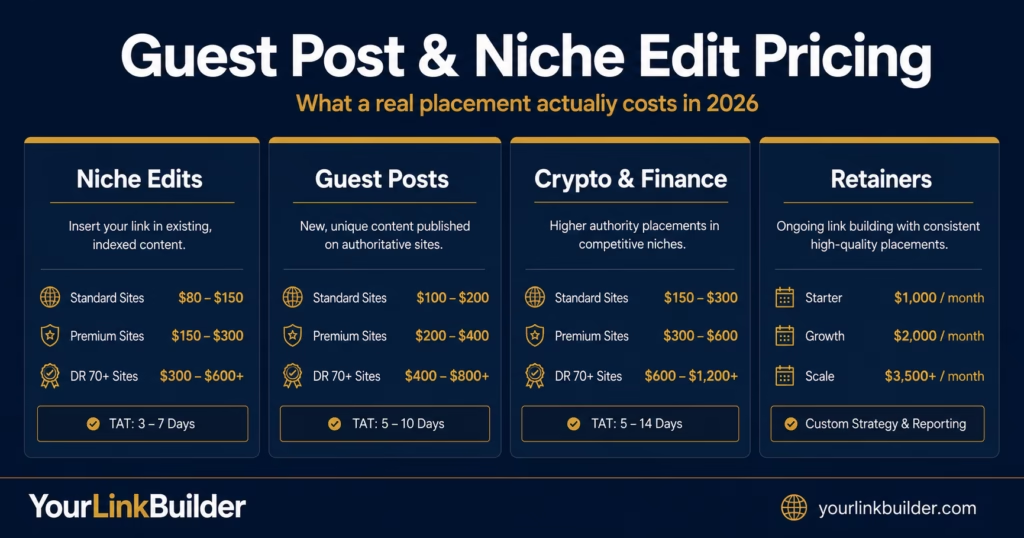
Exact pricing depends on the publisher’s authority tier and niche, but here’s what a fair quote actually looks like at each level:
Niche edits
- Entry-tier sites (real but modest traffic): $120–$220 per placement
- Established, higher-authority sites: $220–$400 per placement
Guest posts (new content + placement)
- Entry-tier sites: $175–$350 per placement
- Established editorial sites with real, engaged traffic: $350–$650 per placement
- Top-tier, highly selective publishers in competitive niches: $650–$1,200+ per placement
Harder or higher-risk niches (crypto, finance, YMYL/health)
- Add roughly 30–50% on top of standard-niche pricing at the same authority tier. This isn’t a markup for its own sake the pool of compliant, editorially safe publishers is smaller, and vetting takes real additional time. We break this down in more depth for crypto specifically.
Monthly retainers (ongoing placements at a set cadence)
- Starter (roughly 3 placements/month): $600–$900/month
- Growth (roughly 6 placements/month): $1,200–$1,800/month
- Scale (10+ placements/month, custom mix of niches/tiers): $2,000–$3,500/month
These ranges reflect real, defensible pricing, not a promotional low-ball number designed to win the first email and get renegotiated later.
Red flags that a quote is too good to be true
- A price that’s dramatically lower than every other quote you’ve received for a similar DR range
- No willingness to show you the actual publishing site before you pay
- No mention of editorial review, content relevance, or approval before placement
- Guarantees of exact ranking positions or timelines no legitimate outreach-based agency can promise this, because ranking depends on far more than any one link
How we price at YourLinkBuilder
We price by publisher tier and niche difficulty, not a single flat rate across our whole inventory, because a guest post on a genuinely relevant, editorially-run site in a hard niche is not the same product as a niche edit on a generic blog. Every site we place on is manually vetted before it goes into rotation, and you approve the specific site before we move forward with any placement; nothing goes live without your sign-off first.
If you want to see where your target niche and budget land, get in touch and we’ll walk you through real options no inflated inventory numbers, no pressure to buy more than you need.
FAQ (add as an FAQ block for schema + AI Overview eligibility)
How much does a guest post cost in 2026? Pricing depends primarily on the publisher’s real traffic and authority, the niche’s editorial difficulty, and whether new content needs to be written. Expect meaningfully different pricing between a general business blog and a vetted, editorially strict SaaS or finance publication.
Is a niche edit cheaper than a guest post? Often, yes, since no new content needs to be written and the host page is already indexed. But the placement’s value still depends entirely on the quality and relevance of the existing page and site, not just the format.
Why do link building quotes vary so much between agencies? Because “a link” isn’t a single product. Inventory sourcing (manual vs. marketplace), editorial standards, niche difficulty, and publisher traffic all vary widely, and most agencies don’t explain which of these their price reflects.
What’s a red flag when comparing link building quotes? Any quote that seems far below the market range for a comparable DR and niche, combined with no willingness to show you the actual site before payment, or guaranteed ranking outcomes.
For the full pricing landscape beyond guest posts and niche edits, see our breakdown of what agencies actually charge in 2026, and if you’re weighing formats, our guest posts vs niche edits comparison covers which gives better ROI.